IAS AC472 Accreditation | Legacy Building Solutions
When selecting a building manufacturer, it's easy to compare building sizes, pricing, and features. But some of the most important differences happen...
Open, enclosed, and insulated configurations for facilities across sports, agriculture, and general use.
Purpose-built for industrial and corrosive environments where standard coatings and structures fall short.
2 min read
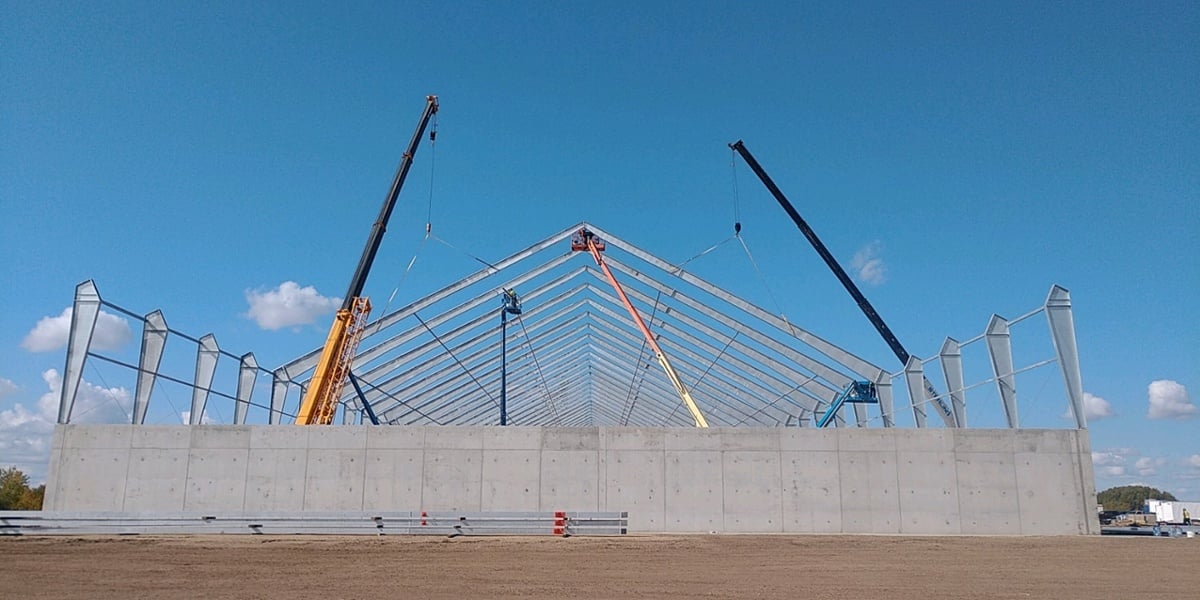
Every building depends on a strong foundation, and tension fabric structures are no exception. A well-designed foundation improves safety, durability, and long-term performance, and it protects your investment for decades. Although these buildings are relatively lightweight, the foundation must keep the frame securely anchored, transfer loads into the soil, and resist movement when wind, snow, and collateral loads are applied.
Most owners install these buildings as permanent facilities, so the foundation should also be treated as a permanent installation. That may require more engineering and higher initial cost, but it typically results in lower maintenance and better performance over the life of the structure.
The cost and design of a foundation for a tension fabric structure depend on several site- and building-specific factors, including:
Two similar buildings can require very different foundations if they are installed on different sites. For example, a structure on soft, compressible soils may need deep piers or piles, while the same building on dense, well-compacted gravel might use shallow footings. A foundation engineer should evaluate these conditions on every project to ensure the design meets local codes and the operational demands of your facility.
Below are seven foundation systems commonly and successfully used to support tension fabric structures. Each can be adapted to suit specific site conditions, budgets, and building uses.
Each of these seven foundation types can be engineered to handle site-specific loads and conditions. For instance, a slab on grade with thickened edges may be ideal for an equipment storage facility, while screw piles or precast ballast can accelerate construction schedules on remote or environmentally sensitive sites.
Building and project design consultants, together with a qualified foundation engineer, can help you compare how each option performs under your expected wind, snow, seismic, and collateral loads. Their expertise will ensure that your chosen foundation is safe, code-compliant, and optimized for your operations.

Building construction involves a significant investment of money and time. Protect that investment with a stable, properly engineered foundation designed specifically for your tension fabric structure and your site conditions.
When selecting a building manufacturer, it's easy to compare building sizes, pricing, and features. But some of the most important differences happen...
As specialty building systems gain traction across municipal, industrial, aviation, and recreational markets, more general contractors are managing...
The future of industrial construction is entering a new era, with the future defined by speed, flexibility, and smarter choices. Looking ahead in...